
How to Market to Persian-Speaking Customers: A Practical Guide
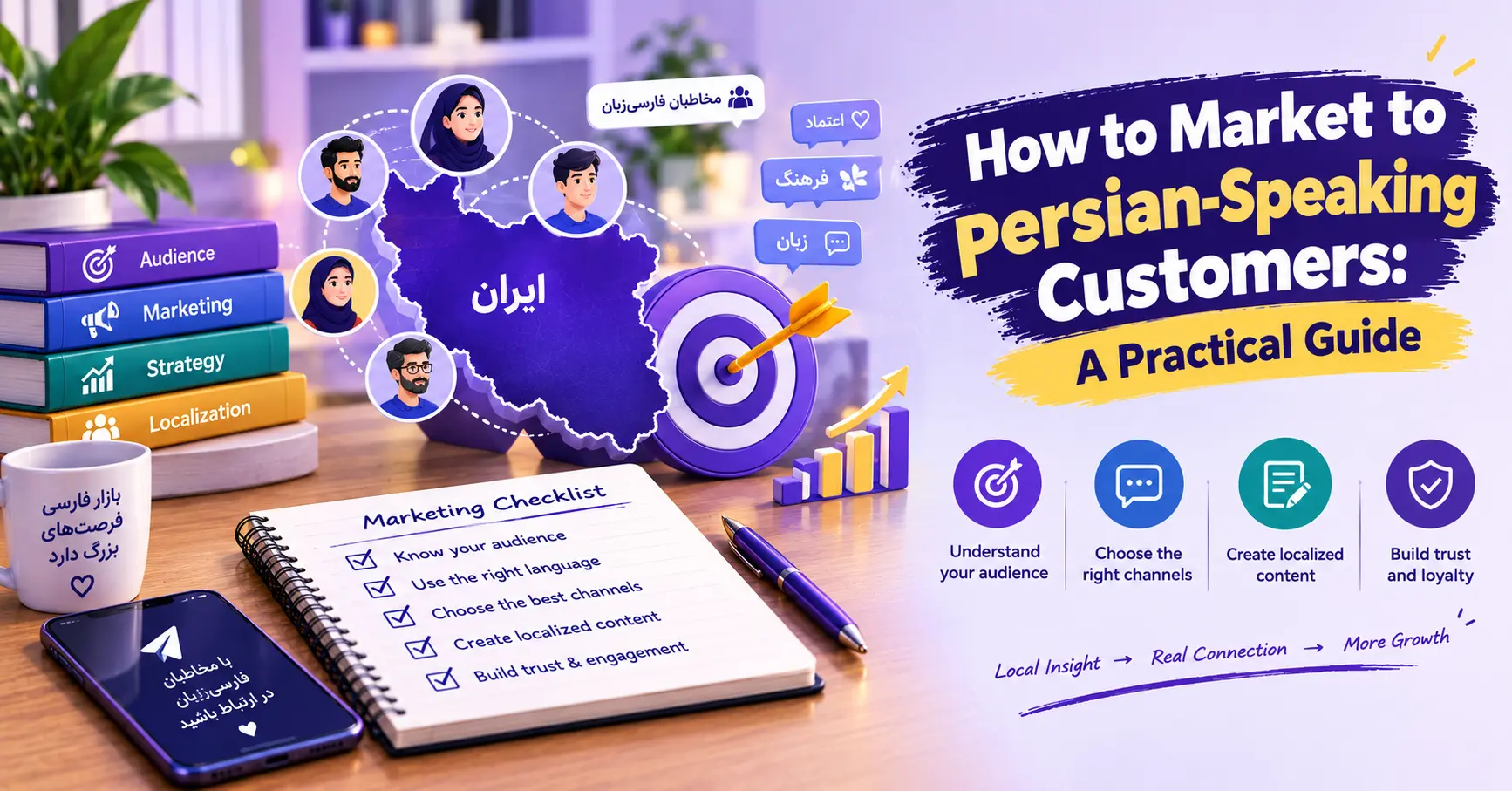
Most agencies treat "marketing to Persian speakers" as a translation problem: take the English campaign, run it through a translator, ship it. That approach usually fails, and not because the translation is bad. It fails because the Persian-speaking audience — spread across Iran and a large global diaspora in North America, Europe, and the Gulf — behaves differently from the audience the original campaign was built for: different dominant channels, different payment realities, and a language with structural quirks that break naive keyword research.
This guide covers what actually determines whether a campaign reaches this audience, based on running a bilingual (Persian/English) marketing operation ourselves.
Who is the Persian-speaking audience, really?
It's not one market. Three distinct groups get lumped together under "Persian speakers," and campaigns that ignore the difference misfire:
- Iran-based consumers and businesses. Subject to international payment restrictions — most cannot use Meta Ads or Google Ads billing directly, and many Western SaaS tools block Iranian IPs or card billing entirely.
- First- and second-generation diaspora in the US, Canada, Europe, and Australia — often bilingual, comfortable in both languages, but still searching in Persian for culturally specific needs (a Persian-speaking lawyer, a Persian grocery store, Persian-language content).
- Persian-speaking communities in the Gulf and neighboring countries — a large, often-overlooked segment with its own payment and platform norms.
A campaign aimed at "the Iranian market" that ignores the diaspora — or vice versa — leaves real reach on the table.
Channel reality: Telegram is not optional
The single biggest mistake we see: budgeting for this audience the way you'd budget for a Western one, with Instagram and Facebook as the default and Telegram as an afterthought.
For Persian-speaking audiences, Telegram is a primary channel, not a secondary one — used for everything from news to e-commerce to customer service, at a scale that has no real equivalent in most Western markets. It also has no accessible self-serve ad platform for small and mid-size advertisers, so reaching it means buying placements directly from channel owners, not running a campaign dashboard. Any media plan for this audience that doesn't budget time and money for Telegram is planning for the wrong market.
Instagram remains the dominant visual/social channel and works largely as it does elsewhere, with one caveat below.
Payment and platform access is a real constraint, not a footnote
If the audience or the business itself is Iran-based, standard ad platform billing is often not accessible at all — this is a sanctions-driven restriction, not a platform preference. Two practical implications:
- Don't assume Meta Ads or Google Ads is available to every client or every audience segment. Confirm billing access before building a paid-media plan, not after.
- Diaspora-based businesses (a restaurant, law firm, or import business run by someone abroad) usually don't have this constraint, but their customers — if some are still Iran-based — may only be reachable through non-billed channels: organic content, Telegram, WhatsApp, or SEO.
This single fact reshapes a lot of channel strategy that a generic international playbook would get wrong.
Persian SEO has its own structural quirks
Persian is a right-to-left script with real technical and linguistic details that break assumptions built for English or even other RTL languages:
- Two letters, same sound, different keyboards. ی/ي (Persian ye vs. Arabic ye) and ک/ك (Persian kaf vs. Arabic kaf) are functionally the same letter to a reader, but different Unicode characters depending on which keyboard typed them. Search volume for the "same" query often splits across both spellings — and building separate pages for each variant creates doorway-page duplication instead of capturing more traffic.
- ZWNJ (zero-width non-joiner) is load-bearing in Persian — it controls word-joining (e.g., compound words and the possessive/plural boundary) and is easy for non-Persian-speaking developers or translation tools to drop or mishandle, silently breaking readability and search matching.
- Persian digits (۰–۹) are visually distinct from Arabic-Indic and Western digits and appear in dates, prices, and phone numbers; content and structured data should be consistent about which digit set is used.
- Keyword research tools built for English (and even most "Arabic-script" tooling, since Persian isn't Arabic) systematically under-report Persian search volume and miss these spelling-variant splits. Real Persian keyword data — not an English tool's guess — is the only reliable input.
None of this is exotic once you know it; it's just invisible to a team that hasn't worked in the language.
The translation-vs-localization gap
A literally translated English ad usually reads as foreign — not because the words are wrong, but because the rhetorical structure differs. Persian marketing copy tends to lead with a relationship-oriented or narrative opening rather than the direct benefit-first hook common in English direct-response copy; a word-for-word translation of an English hook often lands as abrupt or impersonal to a Persian-speaking reader. The fix isn't a better translator — it's writing the copy in Persian from the brief, the way our Persian ad-copy guides are written natively rather than translated.
A practical checklist before you launch to this audience
- Confirm platform billing access for the specific audience segment — don't assume Meta/Google Ads is available.
- Budget for Telegram as a primary channel if the audience skews Iran-based or first-generation diaspora, not as an Instagram afterthought.
- Use real Persian keyword data, not an English tool's transliteration guess, and account for the ی/ي and ک/ك spelling split.
- Write copy in Persian natively, or have it reviewed by a native speaker for rhetorical fit, not just grammatical correctness.
- Segment Iran-based vs. diaspora audiences in targeting and channel choice — they are not interchangeable.
Frequently asked questions
Is Persian the same as Arabic for marketing purposes?
No. Persian (Farsi) uses a modified Arabic script but is a distinct language with its own grammar, vocabulary, and — critically for SEO — its own keyword-research and Unicode quirks. Tools and agencies built around Arabic-market expertise do not automatically transfer.
What's the single biggest channel mistake brands make with this audience?
Underinvesting in Telegram. Most Western media plans treat it as optional or skip it entirely, which misses a channel that functions as a primary platform — not a secondary one — for a large share of Persian-speaking users.
Can I run Google Ads or Meta Ads to reach Iran-based customers?
Billing access depends on the advertiser's own entity and banking location, not the audience's location — an advertiser with a legal entity and payment method outside Iran can generally run ads targeting Iran-based users. An Iran-based business itself typically cannot access these platforms' billing directly. Always confirm actual billing access before planning a paid-media budget.
Do I need separate content for Iran-based and diaspora audiences?
Often yes, at least in channel strategy and payment/CTA design (a diaspora audience can usually complete an online purchase or booking directly; an Iran-based audience may need a non-billed path). Core brand messaging can stay consistent if the underlying offer is culturally adapted rather than literally translated.
---
We run this agency bilingually ourselves — this site's Persian and English content are built, not translated, separately for each audience. If you're building a campaign for Persian-speaking customers and want a team that already knows where the channel, language, and payment assumptions break, our digital marketing services start with a free consultation.
For Persian-language readers, our Persian content library covers these topics in much greater depth, written natively for that audience.
Author: Marketex Strategy Team · Last updated: September 2026